Data study
Deleted Reddit posts: how much of Reddit do authors delete themselves?
The share of Reddit posts and comments that are deleted by the authors who wrote them. Note that this is based on copies of Reddit, not the actual site, and there are limitations to what numbers can tell you.
By Dmytro Krutytskyi, KissMyPost ResearchPublished Data through September 202619 min read
In a public copy of Reddit from October 2025 through September 2026, 1.8% of posts had been marked as deleted by the author who wrote them. 0.3% of comments; this is a sample that covers four of those months.
Check your own subreddit
See when your subreddit is most active, what gets posts removed and who writes there.
You might be wondering: just how common are deleted Reddit posts, really? On the surface, this sounds like a simple question with a single answer, but it’s not. Your own deleted post will only count towards the numbers here if the deletion was recorded before the copy of Reddit was taken in its current state.
The dataset contains 471 million posts, but only those from the last twelve months. 131 million comments were sampled, and those comments were drawn from a narrower range, four months within that span. So you could go back further in time and see what percentage of posts and comments were deleted then, and compare that to more recent collections. You could also look at how old the copies of comments are. The guiding question is simple: what proportion of posts and comments were deleted by their authors, as indicated in the copy of Reddit?
How many Reddit posts are deleted by their authors?
In the period from October 2025 to September 2026, 1.77% of posts on Reddit were flagged as having been deleted by the author, according to the publicly available copy of Reddit. This is below one in fifty posts, and represents only a minimum count of posts with the “deleted” flag. It does not show if the authors chose to delete them or not.

Screenshot of reddit.com, captured Nov 15, 2026
Reddit comments during the same time period (October 2025 through September 2026), taken as a 10% sample and spanning four months, have 0.34% of comments with the author-deleted mark. This is a lower share than posts, but it’s not necessarily evidence that posts are deleted more often than comments, as I explain later.
If you divide both figures up by month, they shift:
For posts, over the same period of October 2025 through September 2026, the monthly share ranges from 1.13% to 2.28%. For comments, over the four sampled months, it ranges from 0.25% to 0.44%.
Both of these counts are lower bounds; they capture each post only once, at the moment that it was copied. If the author deleted it afterwards, it could still appear “live” to a visitor, unless and until the page is rechecked at some later date. The schedule on which rechecks occur is not visible, so all you can see are the posts that were gone when they were last copied.
It’s important to distinguish between a post being deleted and one being removed. In the period October 2025 to September 2026, takedown requests, Reddit, AutoModerator or moderators removed 16.2% of posts, according to the removal field, which I tallied separately. Such posts were also considered deleted if they had the text [removed] in their body. These can be read as removed first, but neither the remover nor deleter is identifiable; I’ll discuss this later.
Deleted-flagged posts were recorded differently starting January 2026. In the period August 2023 to December 2025, 55.6% of deleted-flagged posts still had a living author, whereas since January 2026 only 0.3% do. So the above twelve-month figures are a mix of two different ways of recording deleted posts.
Does the share of deleted Reddit posts differ between copies?
The number of deleted posts you see depends not just on when you’re looking, but also on how the copy recorded events. Comments have a timestamp on the copy, so that’s where it starts. Here’s the median amount of time the copy waited to log a comment, for each month.
Source: KissMyPost analysis of public Reddit posts and comments. A random sample of comments each month, smaller than and separate from the 10% sample used elsewhere; n is in the CSV. This diagnostic sample did not exclude bots or profile pages; excluding known bots moved the median by 0.3% or less on three test months. No value for February to June 2021.
Between 2015 and May 2023, the median delay before a comment was copied, each month, ranged from 9 to 302 days, with erratic swings from one month to next.
Since June 2023, the copy date seems to indicate that copying happened within hours, but I don’t know what time the deleted state was recorded at, so I can’t measure that. It could be, for example, that the copy checked again some time later, on an unseen schedule.
The same is true for posts: they too show a huge gap between the collection of older posts and the more recent ones. Timing and format might both play a role, and it’s impossible to separate them.
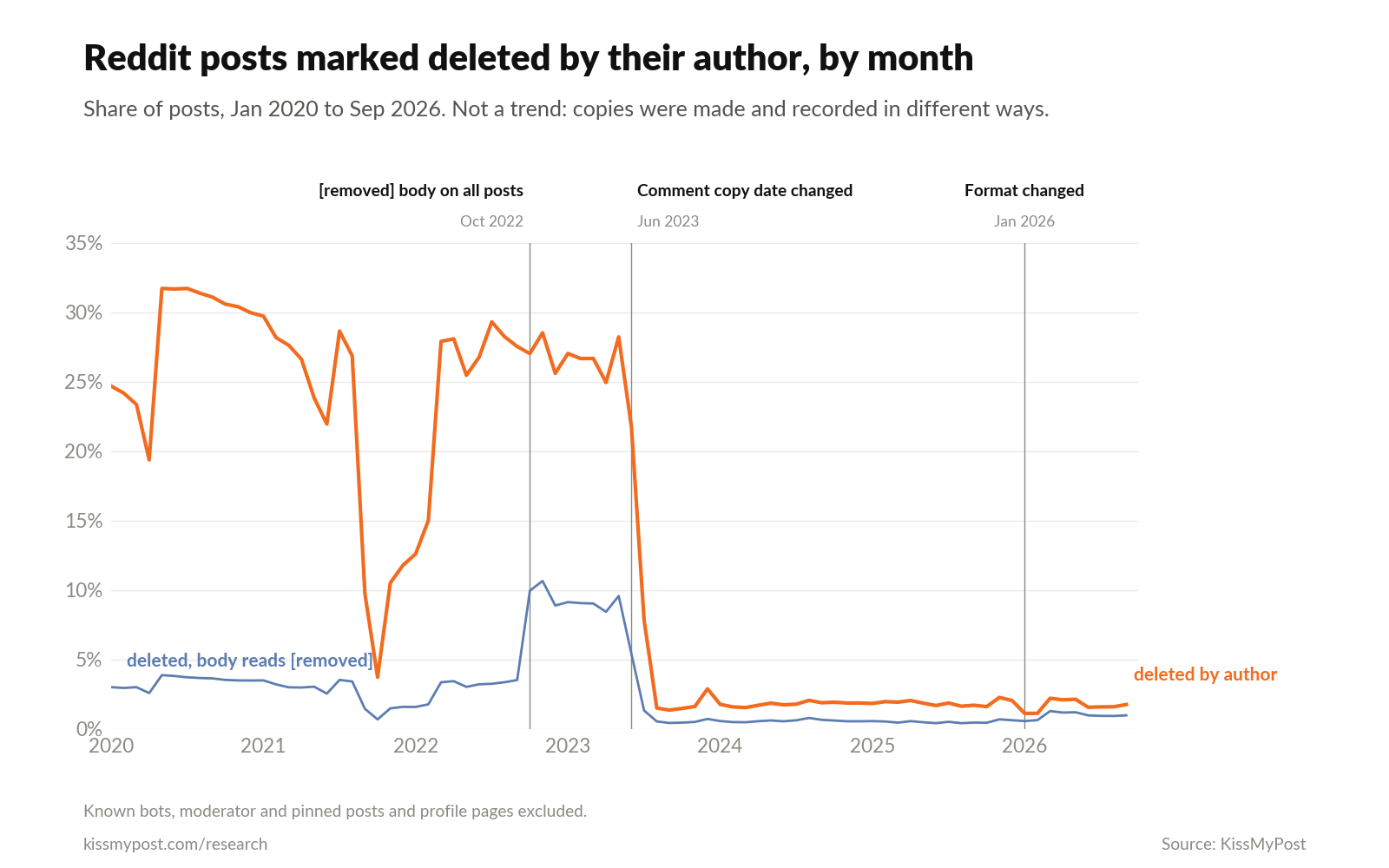
I thought this was my most important finding: the monthly proportion of posts that were flagged as deleted by their authors:
Source: KissMyPost analysis of public Reddit posts and comments. Posts by known bots, distinguished moderator or admin posts, pinned posts and posts on profile pages excluded. Not a trend. The dip from September 2021 to February 2022 looks like a gap in how deletions were recorded, and I don't know why. Before October 2022, removed first covers text posts only.
In the older collection, from June 2022 through May 2023, 27.2% of posts were flagged as deleted by their authors. In the more recent collection, from October 2025 through September 2026, it flags only 1.8%, which is much lower. It’s possible that the two collections were recorded in different ways. The claim that people just stopped deleting isn’t supported by the data.
It’s also possible that the collections saw each post at different points in time, but there’s no way to measure exactly when a post was seen. And it’s possible that the deleted-post recording process differed between the collections, and that the year difference matters as well. These are not separate factors; they’re all intertwined.
| Kind | Period | Deleted by author | Items |
|---|---|---|---|
| Posts | Jan 2020 to May 2023 | 25.15% | 1,063,258,296 |
| Posts | Aug 2023 to Sep 2026 | 1.80% | 1,383,478,656 |
| Comments | through 2014 | 7.82% | 45,862,278 |
| Comments | From 2015 to May 2023 | 4.37% | 463,444,194 |
| Comments | since mid-2023 | 0.30% | 380,607,393 |
Comments are a 10% sample. Through 2014, comments were recorded months to years after posting; from 2015 to May 2023, weeks to months after; since mid-2023, the copy date says within hours, but when the deleted state was recorded isn't known. The comment row from 2015 to May 2023 includes April 2021, which has no copy date. For posts, the period from September 2021 to February 2022 changed how deletions were recorded, which pulls the figure for January 2020 to May 2023 down; the copy date for posts is unknown.
Note that comments are only collected as a 10% sample. Until 2014, there was a lag of months or even years between when a comment was posted and when it was captured. Since mid-2023, the copy timestamp has been recorded within hours, but the time at which the post’s deletion status was captured is unknown. The copy date of posts is not known.
The shares in this article are drawn from collections gathered at different times and logged differently, so it is impossible to know what timing contributes to the gap from these figures alone. This is not a timeline of behaviors. The highest share is in comments that were copied months or years after the original, and the lowest is in cases where the copy date reads “within hours” of the original. The headline of this article would change dramatically if a different copy was chosen.
How many deleted posts had a [removed] body?
This wasn’t something I set out to analyze, but rather something that came up in the data. There are two distinct possible interpretations of an author-deleted post, as far as the available data lets one read:
There are two kinds of deleted posts: those where the body of the post still shows up (without the [removed] mark) and those where the body of the post already shows up with the mark. Since October 2022, the mark has appeared on both text and non-text posts. Neither the completeness nor the reliability of the mark have been measured.
From January through September 2026, deleted posts with a [removed] body constituted 57.6% of all deleted posts, more than half. I interpreted these as having been removed first, and I split them overall and by whether they were labeled “not safe for work” (NSFW).
Source: KissMyPost analysis of public Reddit posts and comments. 356,794,781 posts; intervals from resampling months. "No visible removal" is an upper bound.
From January through September 2026, at most 0.72% of all posts were marked deleted but had no visible removal, so this is an upper bound.
Do NSFW posts get deleted differently?
In the most recent collection (January through September of 2026), I see no visible difference, with NSFW posts at about the same rate as other posts: 0.64% vs 0.79%, and the intervals overlap, suggesting they’re about evenly matched. However, NSFW was higher in the older collection, and also in August 2023 through December 2025.
The difference is in how these posts were deleted. NSFW posts were much more likely to be deleted with a “[removed]” body. In the same span of time, 1.42% of NSFW posts were deleted in this way compared to 0.63% of other posts, over twice the rate.
I know the type of mark, but not why it was done. The format has been in use since January 2026, and when a post is deleted, the author is almost always removed. It’s not clear if the person deleted it themselves, or their account disappeared. I haven’t checked to see if when an account is closed, its posts are marked deleted.
Are Reddit comments copied later more often already deleted?
The older collection is still valuable because things move so slowly.
Some comments were captured within days, while others were captured a month or two later. They were compared within one month. Already-deleted frequency by age, one week through two months, versus baseline copies between three and seven days.
Source: KissMyPost analysis of public Reddit posts and comments. 10% sample of comments; model estimate with a month effect; the baseline age appears in 7 months and one to two months old in 19, and only 6 months have both. Intervals in the CSV.
I have data on comments from 2015 through May 2023; there are enough comments at both ages to make meaningful comparisons, about six months of data at each age. The copies of comments that had been up for one to two months were already more likely to be deleted than the copies that had been up for three to seven days. The median difference in the share deleted was 0.7 percentage points.
In those months, the gap between the copies that had been up for one to two months and the copies that had been up for three to seven days was between 0.6 and 3.3 points. This means that even later copies of a comment were already more likely to be deleted than earlier ones.
It’s not clear whether this is because different comments were deleted at the two times, or whether the same comment was deleted at a later time. It’s also not clear what happened on the first day; there aren’t enough months with such young comments to estimate that reliably.
Are posts or comments marked deleted more often?
If you compare posts and comments in terms of their raw share (the number of posts or comments deleted divided by the total number of posts or comments), that number is higher for posts than for comments, at least when you compare across all windows of time since 2020. The only exception to this trend is in October 2021, where the line representing posts dips below the line for comments; I recorded the reason for that in a previous entry. In 2026, there are three months where comments were sampled, and in those months, posts’ raw share is higher than comments’ 0.37%. That raw share for posts includes posts where the entire body of the post was removed, i.e., “[removed]”. If you look only at posts where the removal isn’t visible, the upper bound for posts is 0.70% of posts. That cut alone can’t tell you the direction.
I doubt this reflects users removing their own posts more frequently than comments. It’s possible that posts and comments are flagged deleted in different ways and their copies are checked at different times. A narrower claim would be that posts are flagged deleted at a higher rate than comments, but there’s no multiple involved.
How much does it vary between subreddits?
There are 33,513 subreddits with at least two thousand posts in this dataset. These are the posts that were flagged author-deleted in the copy, from October 2025 to September 2026.
The median subreddit has 1.32% of posts deleted by the author. In fact, nine in ten subreddits have 2.86% or less.
Note that I left the ranking out, because a handful of particularly prolific posters can skew a subreddit’s number. The top spots are full of subreddits used for testing, run by bots, and advertising adult content, so I dropped the list. However, the total number of subreddits is provided, to give a sense of how broad the communities represented in this dataset are.
Try itPosting activity and removals for a subreddit you pick: Subreddits
Are people deleting more than before?
It’s an undetermined question, at least based on this data, since it’s impossible to know whether the copies of comments have been changed to appear faster or slower, or if any posts have been removed entirely, so these periods aren’t strictly comparable. It’s even an issue within the older collection.
[removed] body comments were more than twice as common in July 2022 than July 2016. The sampled share was 4.91% in July 2022, and 2.05% in July 2016. If a comment was removed-then-deleted, it is tallied only once, in just one state. So the rise or fall of the deleted-share could just be a reflection of comments moving from one state to another.
So how much of Reddit gets deleted?
In comments from 2015 through May 2023, what percentage was deleted? Comments were compared to other comments from the same month. Copies that were one to two months old were more likely to have been deleted than copies that were only three to seven days old.
The number of deletions shown here is how many were flagged in the copy of the site used to make this, which means there’s an unknown snapshot moment for each post, and it’s not possible to pin down exactly when they were deleted for comments.
In January through September 2026, more than half of the deleted-marked posts in the data with a [removed] body are interpreted as having been removed first. Who removes posts? What survives in business subreddits? Which ones require karma and account age?
The reader might be interested in exploring another aspect of Reddit deletions; if so, let me know and I’ll see what I can find!
What this data can't tell you
An important thing to keep in mind about these proportions is that they represent floors for the deleted-flag, not for when authors intentionally removed their own content. The proportion showing zero visible removal, on the other hand, represents a ceiling. There could still be items deleted after the copy of the item was captured that would still appear intact in this data.
Another limitation of this data is that modern comment collection only goes back to the middle of 2023, but the copy dates on the copies indicate that some copies were made only hours after the original was posted or commented on. Unfortunately, the date that the post copy was taken isn’t recorded. For both types of items, it’s not known precisely when the deleted-flag was recorded, and the monthly proportions could vary by a factor of two. It’s possible that the timing of this process has changed since the main period of collection, so the monthly figures presented here could be a mix of one or more processes.
The format in which the deleted-post flag is recorded varies over the course of collection, and comments are also different in terms of when items are checked for deletions. Since the timing of posts themselves is unmeasurable, it may have changed too, and is inseparable from the format. Therefore, the gap between these periods is no evidence of a behavioral shift.
From October 2022 on, deleted-flagged posts with “[removed]” in the body of the post (for text and non-text posts) were counted as “removed” first; comments don’t have this marking. Since the completeness of the marking isn’t measured, the number of posts with no visible removal is an upper bound. Deleted-post recording changed again in January 2026. There, it was split by whether the post had “[removed]” in the body of the post (for text and non-text posts), but only; January through September 2026. Earlier months are considered a separate regime.
Comments are a 10% sample of the data (Jan, Apr, Jul, Oct), while posts are recorded in full. The month-resampling intervals are wide, and each rests on only a dozen months at most, maybe even just a handful.
I counted posts and comments, not the people who deleted them. I did drop known bots from this analysis, but most deleted comments and posts after January 2026 had blank authors fields. I couldn’t see any obvious bots there, and I never tried to quantify what effect they’d have on shares. I did allow, though, that accounts could have been removed for other reasons besides someone deliberately hitting delete.
Posts and comments were flagged for deletion differently, and perhaps checked at different times. So the rising number of deleted flags on posts isn’t necessarily evidence that people are deleting more. Similarly, while “[removed]” comment bodies are now over twice as common in July 2022 than July 2016, a comment that was removed then deleted would only be counted once. The apparent shift in the share of deleted content over the years might just be a reshuffling between those two states.
Finally, this analysis doesn’t get at why things were deleted or who deleted them, because, well, nobody read the deleted content. All I checked for in the body fields were instances of “[deleted]” and “[removed]”, and nothing else is stored there. (User profile pages were partially excluded prior to August 2021, and subreddit names are gapped in that dataset). Additionally, data prior to March 2018 may be different, so comparisons across it are weaker.
There were many cuts examined, and no multiple-comparison correction was done. Removal-order and NSFW splits were added as an afterthought, after the rest of the analysis was already planned out. The direction reported here is consistent across all cuts run. However, some findings from a single cut should be flagged, such as the one about NSFW posts where the removal isn’t visible in the post body. That finding is only true from January to September 2026. Older collection, and August 2023 to December 2025, the NSFW posts did score higher, though that older figures is only a crude upper bound. In those cuts, the ratio of NSFW posts with [removed] in the body was less than 2.
Method
| Step | What |
|---|---|
| Data | Public Reddit posts and comments. Posts are a full count; the main window is October 2025 to September 2026 (471,104,162 posts). Comments are a fixed 10% sample in January, April, July and October of each year (131,160,322 comments in the main window). |
| Excluded | Accounts on KissMyPost's list of known bots, posts distinguished as moderator or admin posts, pinned posts, distinguished (moderator or admin) comments and user profile pages. Posts removed by moderators or Reddit stay in the denominator. |
| Deleted by the author | A post counts when the removal field says deleted or author; a comment when its body reads [deleted]. No language model classified any text, and no post or comment text was stored. |
| Comments through 2014 | Copied months to years after posting. |
| Comments, 2015 to May 2023 | Copied weeks to months after posting. February to June 2021 has no copy date and is left out of the age comparison and the delay chart; April 2021 is still in the collection-periods table. |
| Comments since June 2023 | The copy date says within hours; when the deleted state was recorded is not known. |
| Posts | The copy date is not recorded. June and July 2023 are transition months and sit in no window. The older post window is June 2022 to May 2023 (353,599,600 posts). |
| Age comparison | Comments from 2015 to May 2023, compared inside each month, one to two months old against three to seven days. Model estimate with a month effect: 0.7 points (0.6 to 0.9). The baseline age appears in 7 months and one to two months old in 19; only 6 months have both with enough comments. Direct gap in those 6 months: median 0.7 points, mean 1.2 (0.6 to 2.1). |
| Intervals | Headline shares use 95% intervals from resampling months: posts 1.56% to 1.98%, comments 0.28% to 0.41%, older posts 26.5% to 27.9%. Monthly series use Wilson intervals, which ignore clustering and are too narrow. |
| Other ways of counting | Without NSFW posts (44.7% of the main window): 1.45%. With known bots left in: 1.69%. Median subreddit with 200 or more posts: 1.15%; with 200 or more sampled comments: 0.29%. The headline post share stays between 1.15% and 1.77%. The comment-age gap held without adult subreddits, with at least 5,000 comments per cell and on a fixed panel of subreddits. |
| Split by a [removed] body | Computed for January to September 2026, the older window, the twelve-month main window and August 2023 to December 2025; shown as a split only for January to September 2026, when the recording format was the same. |
Planned before looking, and found while analysing
| Guess | Result |
|---|---|
| The deleted share of posts and comments in the main window | Reported. The copy delays and a one-month sample of states had been seen before the plan. |
| Comments copied later are more often already deleted | Held, narrowed after review to the six months with enough comments at both ages |
| Deleted shares are higher in sensitive communities (relationships, health, personal finance) | Dropped: the direction differed between the two collections |
| The deleted share of comments rose from 2016 to 2022 at a fixed age | Dropped: the share of [deleted] comments did not rise, and comments with a [removed] body did, so a change can't be read as behavior |
| Posts are deleted more often than comments | Kept only as a direction in how the data marks them |
| NSFW posts are deleted more often | Raw numbers showed it, 2.17% against 1.45% in the main window; it did not hold for posts with no visible removal |
| Found: transition months | June and July 2023 (21.8% and 7.9%) sit between the old collection and the modern one, so they were set aside |
| Found: spring 2023 | Dropping the spring of 2023, the months closest to the June 2023 change, the older collection marked 27.4% of posts as deleted by their author, against 27.2% with them |
| Added after checks | Comments were sampled in four months a year, decided before the first result to keep the run affordable. After a first separate check I added the split of deleted posts into removed first and no visible removal, by NSFW label; after a second I limited it to January to September 2026, when the recording format stayed the same. Rankings of subreddits and topic areas were dropped. |
KissMyPost is a tool for researchers interested in Reddit, built without outside funding. If you have any corrections, please get in touch. When I make a fix, I'll date note it here.
Conflict of interest: KissMyPost makes Reddit research tools. Funding: none.
Corrections: contact me; each fix gets a dated note on this page.
Questions people ask (FAQ)
How many Reddit posts get deleted by their authors?
In the period October 2025 to September 2026, 1.77% of 471,104,162 publicly-copied Reddit posts were deleted by the author. That’s 0.34% of the comments that were sampled. Both are lower bounds; there could have been deletions that occurred after the copy and were not counted. It is also not clear if the author deleted the post themselves or their account disappeared, since in most cases (almost all since January 2026) the author was removed from the post when it was deleted. Separately, in the period January to September 2026, more than half of deleted posts had [removed] as the body of the post.
Does the public copy of Reddit I used record which posts were deleted?
If a post was removed prior to capture, it will carry the “deleted” flag, but other fields (such as author, or if there’s a “[removed]” body) may or may not be present, depending on the period. If a post was removed after capture, it may still be visible in full. The share of posts flagged as deleted varies widely across collections. In the older set (from June 2022 through May 2023), 27.2% were flagged as deleted by the author, while in the modern set (October 2025 through September 2026), it was 1.8%. It’s not possible to untangle the timing effect from the format effect.
Are comments copied later more often already deleted?
Ages are compared only within a single month; there are only six months with enough comments to compare them. Comments are from 2015 through May 2023, and represent a 10% sample of comments. Even within a month, one- and two-month-old copies of a comment are already more likely to have been deleted than three- and seven-day-old ones; the median difference is 0.7 points.
Are posts or comments marked deleted more often?
Unadjusted, the deleted-flag share is higher for posts than comments. It’s also possible that posts and comments are flagged for review under different circumstances and at different times, so it’s not necessarily the case that more posts are deleted by users than comments.
Are people deleting more than before?
I don’t know the answer to this question either; I can only see the apparent timing of comments and posts after they’ve been removed or deleted. The data on comments shows that there were more than twice as many [removed]-body comments in July 2022 than in July 2016, but I don’t know how many comments were removed and then deleted. Each instance of a comment being removed and then deleted would be tallied only once.
The data
Here are the CSVs containing the monthly shares, copy delays, comment-age gaps, and collection periods. The share files contain fractional values (i.e., they’re not percentages), capture_lag.csv is in days, and age_curve.csv is in percentage points. There’s no post text, and no usernames. These files are made available under CC BY 4.0; if you use them, please credit “KissMyPost” and include a link back to this page.
- CSVDeleted posts by month, from 2020 to 2026Share of posts marked deleted by their author each month, with the number of posts and Wilson 95% intervals; June and July 2023 are transition months.
- CSVPosts marked deleted with a [removed] body, by monthShare of all posts that were marked deleted by their author and had a [removed] body, by month, with the number of posts; before October 2022 only text posts carry the mark; this is the share of all posts, and the format changed in January 2026.
- CSVHow long before comments were copiedMedian days between a comment being posted and a copy recording it, by month (x = month, y = median days, n = comments in a separate random sample; bots and profile pages not excluded), with no value for February to June 2021.
- CSVDeleted comments by age when copiedGap in percentage points against comments copied at 3 to 7 days old, within the same month, with 95% intervals and the number of months.
- CSVDeleted comments by monthShare of sampled comments marked deleted by their author in January, April, July and October of each year from 2015 to July 2026, with Wilson 95% intervals.
- CSVCollection periodsShare marked deleted by the author for each period, posts and comments (comments are a 10% sample), with the number of items; for posts the date of the copy is not known.
- CSVDeleted posts: with a [removed] body or not, January to September 2026Share of all posts marked deleted by their author, marked deleted with a [removed] body (read as removed first), and marked deleted with no visible removal, for all, non-NSFW and NSFW posts in January to September 2026 and all posts in June 2022 to May 2023; for June to September 2022 only text posts carry the [removed] mark, so that row's no-visible-removal figure is a very loose upper bound.
- CSVModern and older collectionPosts and comments marked deleted by their author, October 2025 to September 2026 and June 2022 to May 2023.
- PNGMain chart as an imageDeleted posts by month, as an image.
Zenodo DOI: https://doi.org/10.5281/zenodo.24140336
Check your own subreddit
See when your subreddit is most active, what gets posts removed and who writes there.
Related research
- Most posts in Reddit's business subreddits are removed. Here's who removes them55% of posts in 40 marketing, SEO, SaaS and startup subreddits were removed last year; 15% across Reddit. Who removes them, what stays up.
- Subreddit karma and account age requirements, checked on 70,483 subreddits1 in 10 of 70,483 subreddits has a karma or age minimum I found. In the typical subreddit, 49% of day-old accounts' first posts there were removed.
- How many subreddits are there?7.8 million subreddits have had a post since 2005. 388,000 were active in September 2026, 123,000 with 10+ posts. Counts by month, year and size.
- How much of Reddit is bots? About 1 in 20 posts and comments comes from a known bot, and over half of that is AutoModeratorHow much of Reddit is bots: the share of posts and comments written by known bot accounts, by type of bot and by subreddit, from public Reddit data.
About the data
KissMyPost is a Reddit analytics tool: it reads a subreddit's history (posts, comments, removals, rules) and tells you when to post, what format works and who writes there. This study uses the same data: public Reddit posts and comments back to 2005.
What KissMyPost does
About the author
Dmytro Krutytskyi is the founder of KissMyPost, a Reddit analytics tool. He studies what online communities talk about, who writes in them and how audiences overlap, and writes up what the data shows here, with the method and the numbers. Questions about the data, or need a cut we didn't publish? Write to him directly.
Cite this study
Krutytskyi, D. (2026). Deleted Reddit posts: how much of Reddit do authors delete themselves?. KissMyPost Research. https://kissmypost.com/research/how-much-of-reddit-people-delete
Data: Krutytskyi, D. (2026). Deleted Reddit comments (2015-2026) and posts (2020-2026) [Data set]. Zenodo. https://doi.org/10.5281/zenodo.24140336